
Loyalty Program
Unexpected experiences, generous benefits and exclusive rewards. Open the door to endless possibility and get ready to live life to the fullest with ALL, Accor's exceptional loyalty program.
Saigon is often understood through movement. Streets layered with sound. Schedules shaped by distance. Energy that rarely pauses. Yet on the eastern edge of the city, beyond its most familiar rhythms, Buu Long Pagoda offers a different way of encountering Saigon, one defined not by momentum, but by space.
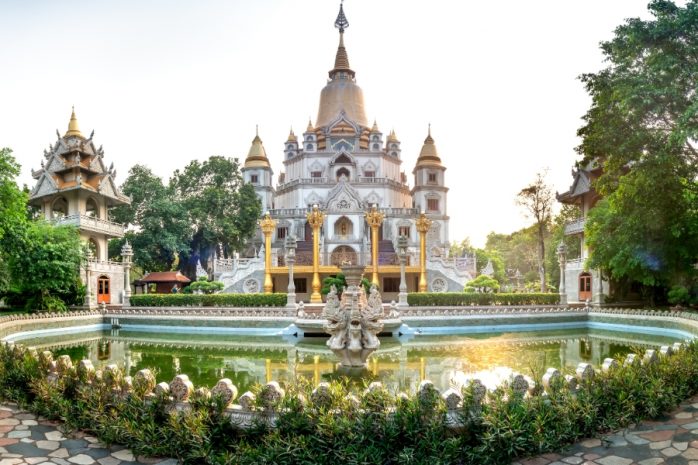
The shift is immediate. Traffic fades. Pathways widen. The presence of water and open ground alters how the city feels, not dramatically, but decisively. Buu Long Pagoda does not announce itself as a landmark. It does not ask for attention. Instead, it creates conditions where attention can settle naturally.
This is not a place to be hurried through or consumed visually. Its character is restrained, its atmosphere reflective. Visitors arrive without instruction and move without direction, walking slowly, pausing where they feel drawn, and leaving when the experience feels complete. What unfolds is not an activity, but a quieter rhythm of Saigon that exists alongside the city’s intensity rather than in opposition to it.
For travellers seeking balance during a Saigon stay, Buu Long Pagoda offers something increasingly valued today: distance without detachment, and stillness without ceremony.
Travel patterns in recent years have shifted in a subtle but meaningful way. The emphasis on speed, volume, and constant stimulation has begun to give way to experiences that allow for restraint and clarity. This is especially true in large cities, where the desire for calm often grows in direct proportion to urban intensity.
In Ho Chi Minh City, this shift is reflected in how travellers choose where to spend their time. Increasingly, they look for places that offer:
Within this context, Buu Long Pagoda holds particular relevance. Located beyond the city’s busiest districts, it allows visitors to step out of motion without leaving Saigon behind. The experience is not framed as an escape, but as a recalibration.
Unlike destinations designed for quick consumption, Buu Long Pagoda offers no checklist and no narrative to follow. Its appeal lies in what it permits: slower movement, quieter observation, and time that feels unstructured. Visitors are neither guided nor entertained. They are simply given room.
For many modern travellers, this kind of pause has become essential rather than incidental. Buu Long Pagoda meets that need not because it has been shaped for it, but because stillness is already embedded in the way the place exists.
Buu Long Pagoda is a Buddhist pagoda located in Thu Duc City, formerly District 9, on the eastern edge of Ho Chi Minh City. Set within a large landscaped compound bordered by water and open grounds, it stands apart from the dense urban fabric that defines much of the city centre.
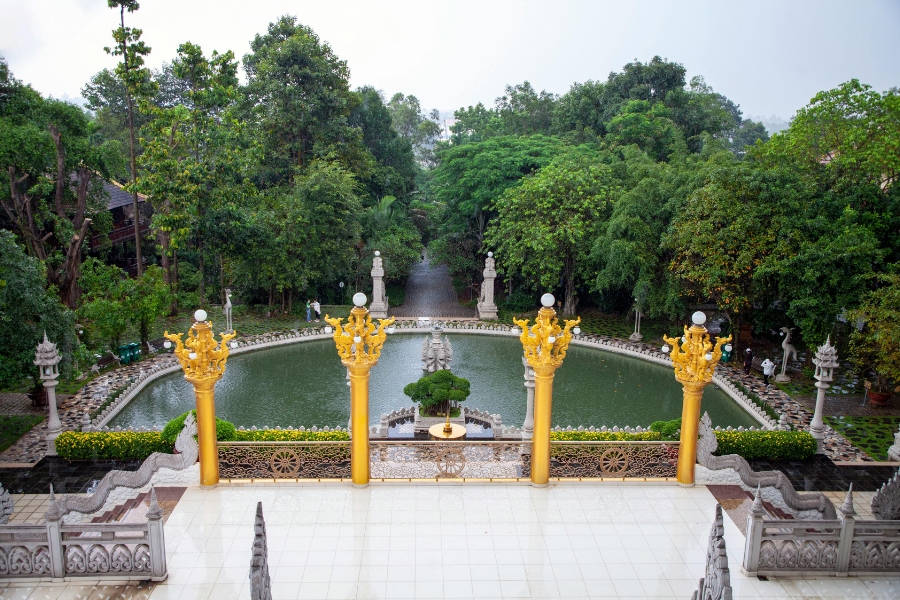
The pagoda follows Theravāda Buddhist traditions, an influence more commonly associated with Thailand, Myanmar, and Sri Lanka. This distinction is evident not only in religious practice, but also in architectural form and spatial planning. Instead of enclosed halls and compact courtyards, the site is organised around openness, symmetry, and long sightlines that encourage unhurried movement.
Buu Long Pagoda remains an active place of worship rather than a curated attraction. Entry is open, and there are no tickets, guided routes, or fixed experiences. Visitors are expected to observe basic etiquette, but beyond that, the visit unfolds according to personal pace rather than instruction.
What most clearly distinguishes Buu Long Pagoda from temples in central Ho Chi Minh City is its relationship with space and silence. While many inner-city pagodas are woven tightly into surrounding streets and daily commerce, Buu Long exists with physical and sensory distance from traffic and crowds. Its atmosphere is contemplative rather than ceremonial, offering a form of spiritual presence that feels grounded, spacious, and unhurried.
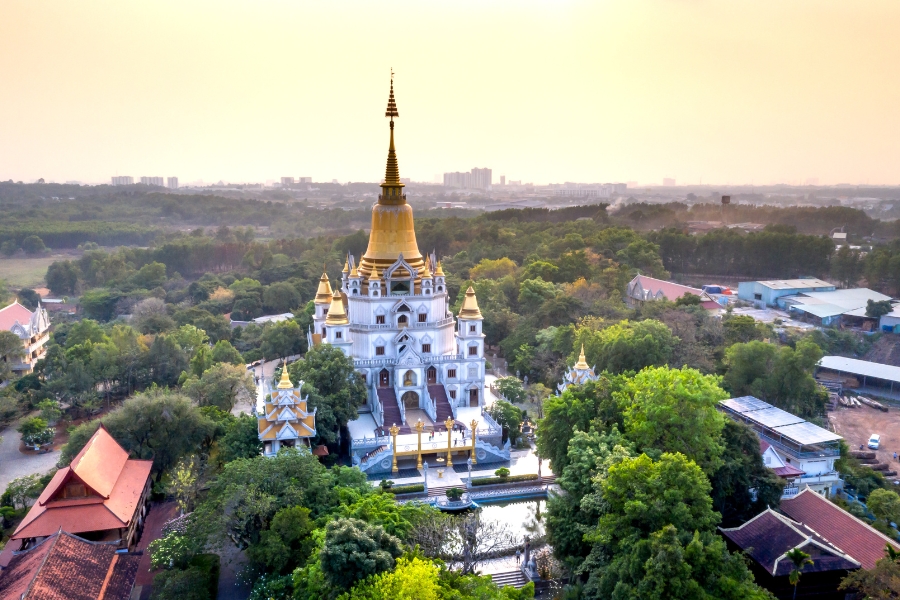
Buu Long Pagoda does not rely on a single defining feature. Instead, its character emerges through a combination of deliberate choices that shape how the place is experienced.
Scale and openness
Where many city pagodas are compact and inward-facing, Buu Long unfolds across a broad landscape. Wide paths and open courtyards allow movement without compression. There is room to walk, to stop, and to observe without feeling directed or in the way. This physical openness naturally encourages quieter, more deliberate behaviour.
A setting shaped by water
The surrounding lake and landscaped grounds create a natural buffer from urban noise. Sound is softened, movement slows, and the presence of water introduces a subtle rhythm that anchors the experience. Even on busier days, the site feels contained rather than crowded.
An absence of commercial presence
There are no souvenir stalls, no vendors, and no transactional interruptions. This absence allows attention to remain focused on architecture, light, and atmosphere rather than consumption.
Designed for contemplation, not performance
While it functions as a place of worship, Buu Long Pagoda does not organise the visitor experience around ceremonies or demonstrations. There is no spectacle to observe and no schedule to follow. The experience remains internal, shaped by walking, sitting, and quiet reflection.
Taken together, these elements answer a question many travellers now ask before visiting: Is it worth the journey?
For those seeking space, calm, and a different expression of spiritual life in Saigon, the answer is found not in what Buu Long Pagoda shows, but in how it allows stillness to exist.
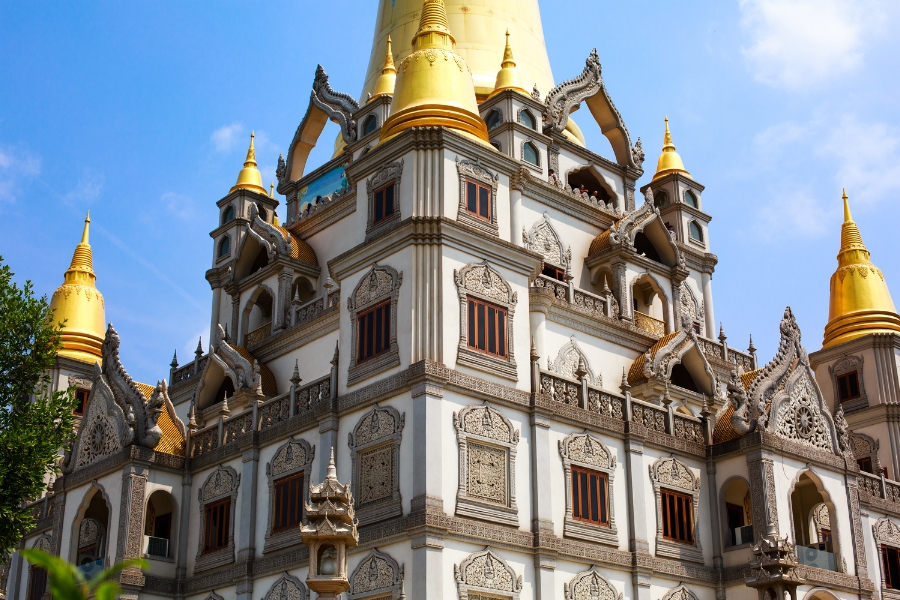
Visually, Buu Long Pagoda feels distinct from many pagodas across Vietnam. Its architecture draws strongly from Theravāda traditions, with ornamental domes, layered spires, and a clear sense of symmetry. Structures rise with proportion rather than ornamentation, using restraint to create visual balance.
Colour is applied sparingly. Lines remain clean. Details feel intentional rather than decorative. This clarity allows the architecture to be experienced slowly, both from a distance and up close. Light interacts gently with surfaces throughout the day, revealing texture without excess.
Where traditional Vietnamese pagodas often feel intimate and enclosed, Buu Long’s design is outward-looking. It reinforces the sense of space that defines the site and contributes to an atmosphere of order and calm.
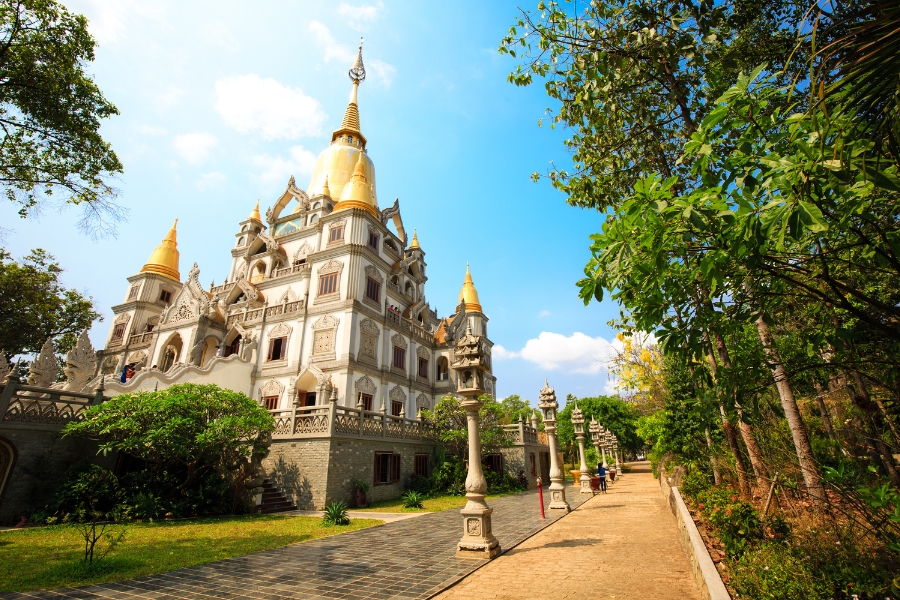
Beyond the buildings themselves, the atmosphere at Buu Long Pagoda is shaped by what surrounds them. Water, open ground, and carefully planned pathways work together to slow movement naturally.
The lake reflects light and softens sound, introducing a sensory stillness that extends across the grounds. Courtyards and wide walking paths allow visitors to move freely, without pressure to follow a route or maintain pace.
This freedom affects not only movement, but attention. Silence is not enforced, yet it emerges organically. Visitors often experience a sense of mental spaciousness that mirrors the physical layout, an environment where thought can settle without effort.
Together, architecture, water, and space create an atmosphere that feels quietly intentional. Not dramatic. Not performative. Simply present.
Arrival at Buu Long Pagoda is understated. There are no ticket booths, queues, or formal entry points. The transition from surrounding streets into the grounds is marked instead by a gradual shift in sound and pace.
Visitors enter freely and disperse naturally. Some walk the perimeter paths, others pause near the lake, while a few sit quietly in shaded areas. There is no defined sequence of highlights and no expectation to see everything.
The atmosphere remains calm and respectful. Conversations are low, phones are used discreetly, and movement is unhurried. Silence is shared rather than imposed.
Most visitors spend 30 to 60 minutes at the pagoda. This is typically enough time to walk, observe, and sit quietly without the experience feeling repetitive. Longer stays are possible, but the visit feels most complete when it ends naturally, preserving the sense of calm that defines the place.
Morning visits tend to feel cooler and more reflective. Light is softer, activity is minimal, and the grounds feel especially spacious. Afternoons bring warmer temperatures and slightly more visitors, particularly on weekends, though the atmosphere remains calm compared to central city temples.
Weekday mornings generally offer the most serene experience.
As an active religious site, visitors are expected to dress modestly, covering shoulders and knees. Hats should be removed in prayer areas. Photography is permitted outdoors when done discreetly, without flash or intrusion.
Behaviour is guided by restraint. Loud conversations and phone calls are discouraged. Participation in rituals is not required; respectful presence is sufficient.
These guidelines are less about rules and more about preserving a shared atmosphere of quiet attention.
Buu Long Pagoda is best experienced as a short, intentional excursion rather than a full-day destination. It works in contrast to time spent in central districts, offering relief from density and pace.
After busy streets, cafés, and cultural sites, the pagoda provides a recalibration. Space replaces movement. Silence replaces noise. This contrast deepens understanding of the city rather than fragmenting it.
For guests staying at Hôtel des Arts Saigon, this rhythm feels especially aligned. Located in District 3, the hotel offers proximity to the city’s core while maintaining a composed atmosphere. Returning after a visit to Buu Long Pagoda allows impressions to settle, supported by calm interiors and attentive service.
Seen this way, the pagoda becomes part of a broader approach to Saigon, one shaped by balance rather than accumulation.
Buu Long Pagoda is not a destination to complete. Its value lies in what it permits: space, silence, and time that unfolds without instruction.
In a city defined by momentum, it offers a reminder that stillness can exist without formality. Visitors are not directed or entertained. They are simply given room to walk, pause, and notice.
What remains after leaving is not a single image, but a shift in pace. An understanding that Saigon is experienced not only through energy and motion, but also through places where attention can rest.
Approached with intention, Buu Long Pagoda becomes a moment of balance within a Saigon journey, defined not by how much is seen, but by how clearly it is felt.
Follow our hotel on: