
Loyalty Program
Unexpected experiences, generous benefits and exclusive rewards. Open the door to endless possibility and get ready to live life to the fullest with ALL, Accor's exceptional loyalty program.
There are places in Saigon that ask for attention, and others that simply exist, allowing the city to unfold on its own terms. Nguyen Hue Walking Street belongs firmly to the latter.
Nothing here announces itself as an attraction. There is no clear starting point, no defined ending, and no instruction on how the space should be experienced. People arrive, pause, move on, and return again, each guided by their own reason rather than expectation. The street does not perform for an audience. It quietly makes room.
At different hours, Nguyen Hue carries different atmospheres. At times it feels open and restrained, shaped by light, scale, and movement. At others, it becomes more expressive, animated by voices, music, and informal gatherings. What remains unchanged is its sense of openness, both in layout and in spirit.
Walking along Nguyen Hue offers an unfiltered encounter with Saigon. Not as a display, but as a city revealed through ordinary moments and collective presence. It is this understated quality that places the boulevard at the centre of Ho Chi Minh City’s public life.
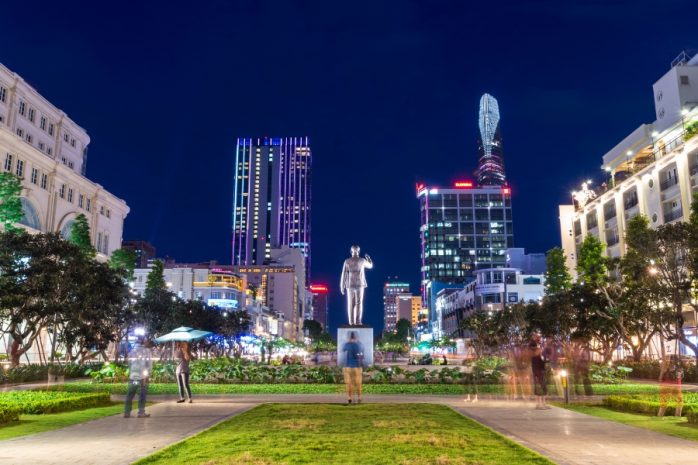
Nguyen Hue Walking Street is a wide pedestrian boulevard located in the centre of Ho Chi Minh City, stretching from the area near City Hall toward the Saigon River. For most of the day, vehicle access is restricted, allowing the street to function as one of the city’s most open and inclusive public environments.
Rather than acting solely as a link between landmarks, Nguyen Hue was conceived as a space to be occupied rather than crossed. Its generous width and unobstructed design invite walking at an unhurried pace, informal gatherings, and moments of pause without direction or obligation. There are no formal entry points, no prescribed routes, and no need for schedules. The character of the street is shaped by those who use it.
What defines Nguyen Hue is not a single feature, but its place in everyday city life. Locals come to exercise, meet friends, or spend time outdoors after the workday. Visitors encounter Saigon in motion, not as a curated scene, but as daily life unfolding naturally through routine and spontaneity.
Viewed this way, Nguyen Hue Walking Street is less a destination to be visited and more a reflection of contemporary Saigon, open, social, and continually shaped by use.
Source: Richard A Francisco
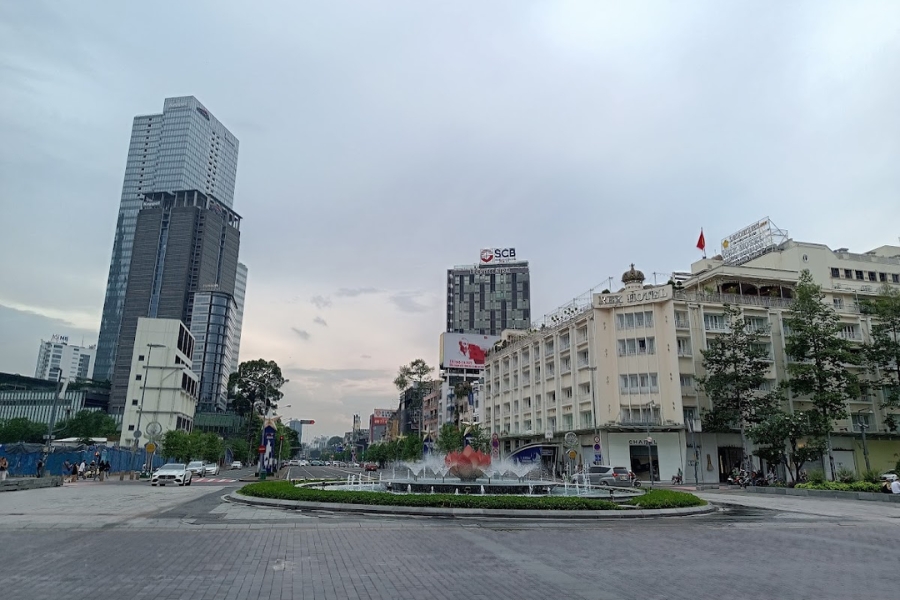
Nguyen Hue Walking Street holds significance not because of what it presents, but because of what it makes possible. In a dense and fast-moving city, it offers a form of public space shaped by daily activity rather than designed spectacle.
Its importance can be understood through a few simple observations:
Because of this, Nguyen Hue Walking Street carries meaning beyond tourism. It shows how Saigon gathers, celebrates, and unwinds in public. Spending time here is less about seeing an attraction and more about understanding how the city functions today, open, social, and constantly evolving.
Nguyen Hue Walking Street is shaped more by moments than by planned activities. What takes place here is unscheduled, influenced by time of day, weather, and the people who arrive.
Soure: dzung1969
In the late afternoon and early evening, the boulevard becomes part of local routine. People walk at an easy pace, some exercising, others meeting friends or spending time with family. Children move freely across the open space while small groups form to talk, watch, or simply pass time outdoors.
These scenes are relaxed and unpolished. There is no expectation to engage or participate. For visitors, this offers a clear view of how Saigon inhabits its public spaces beyond sightseeing, through ordinary gestures and shared presence.
As evening deepens, the mood shifts. Music begins to surface in different corners of the boulevard. A dancer gathers a brief audience. A group rehearses choreography. Someone sings, while passersby pause momentarily before continuing on.
These performances are informal and constantly changing. Some last only minutes, others reappear night after night, becoming quietly familiar to regular visitors. The atmosphere grows livelier, yet rarely overwhelming. Energy builds through curiosity rather than crowd density.
Together, these everyday scenes and spontaneous expressions give Nguyen Hue Walking Street its character, not as a place to follow a plan, but as one experienced through presence, where the city’s movement becomes visible in real time.
Nguyen Hue Walking Street shifts noticeably as the day progresses, offering two distinct perspectives on the same space.
During daylight hours, the boulevard feels spacious and composed. Without the draw of performances or large gatherings, attention naturally turns to surroundings. Historic façades, modern towers, and the long, open axis of the street become more apparent. Movement remains light, with many people passing through rather than staying.
For visitors, daytime provides a quieter opportunity to observe scale, form, and context. It is a moment to understand how the boulevard fits within the city’s structure, shaped more by light and architecture than by activity.
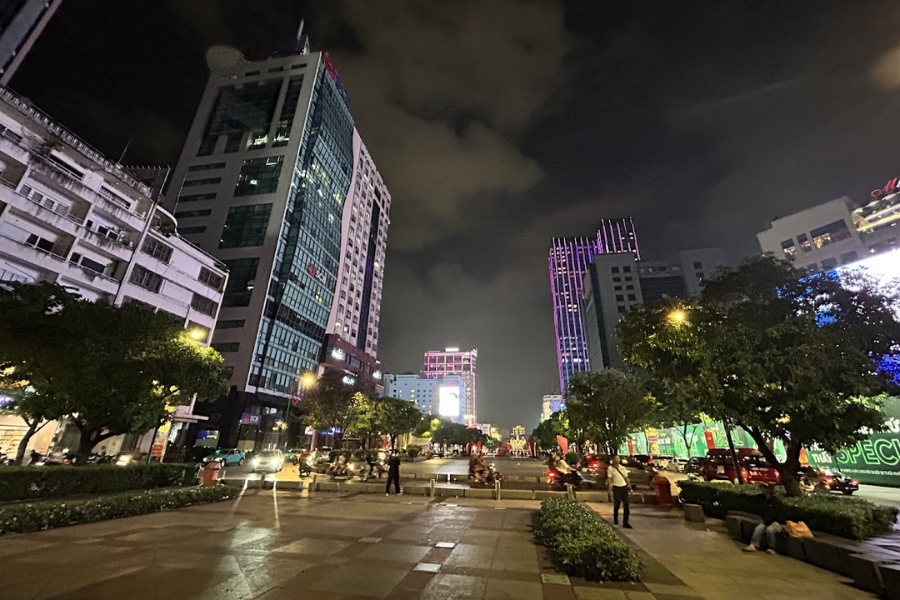
As evening arrives, Nguyen Hue takes on a different energy. Lights come on, temperatures soften, and the boulevard begins to fill. Groups gather, informal performances emerge, and conversations extend into the open space. The atmosphere becomes more social, driven by presence rather than planning.
Nothing feels fixed. One evening may feel energetic, another subdued. Performances appear and fade, and small moments draw attention before dissolving back into the flow of the crowd. The street feels alive, not through spectacle, but through shared experience.
For many travellers, evening visits tend to resonate more deeply. It is after sunset that Nguyen Hue most clearly shows how Saigon comes together, informally and without agenda. Both day and night offer value, yet it is often in the evening that the boulevard moves beyond observation and becomes a lived experience, reflecting the city at its most open and expressive.
Source: J G
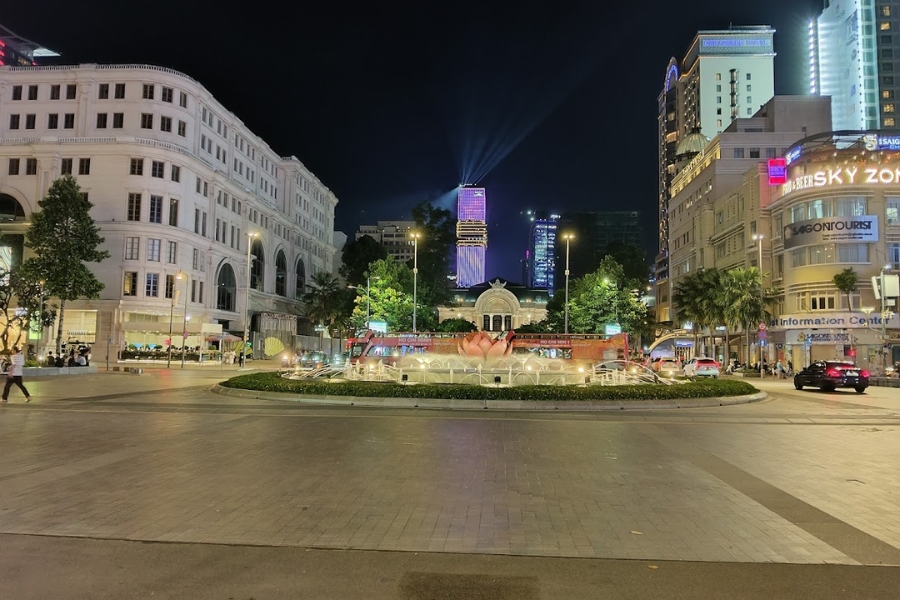
Throughout the year, Nguyen Hue Walking Street serves as the city’s natural gathering point during shared occasions. When Saigon marks an event, it often does so here, openly and collectively.
On major public holidays, the boulevard fills gradually with families and groups arriving early. The space transforms into a shared arena shaped by anticipation rather than urgency. Music, light displays, and public performances may appear, but the atmosphere remains grounded in participation rather than spectacle.
What draws people here is not a single event, but the sense of being part of something larger. Nguyen Hue offers visibility, openness, and enough room for the city to gather without constraint.
During Tet, the Lunar New Year, Nguyen Hue takes on a quieter, more reflective tone. Decorative installations line the boulevard, colours soften the space, and movement slows. Families walk together, take photographs, and linger longer than usual.
The experience during this period is less about motion and more about presence. Nguyen Hue becomes a place to mark transition, from one year to the next, from routine into reflection.
During large celebrations or countdowns, the boulevard can feel crowded, particularly in the evening. Movement slows and the atmosphere becomes denser. For visitors, this offers a direct view of how Saigon gathers in public, informally and without barriers.
Those seeking quieter moments may prefer earlier hours or non-event evenings. Others may find that these peak occasions provide the most vivid sense of the city’s collective energy.
In every case, Nguyen Hue Walking Street remains consistent in its role. It does not stage the city’s celebrations. It simply holds them, allowing public moments to unfold naturally through those who arrive.
he experience of Nguyen Hue Walking Street is shaped less by schedule and more by light, temperature, and daily patterns.
Late afternoon, around 4:30 to 6:00 pm, offers a gentle transition as heat eases and the street begins to fill. Early evening, between 6:30 and 8:30 pm, is often when the boulevard feels most animated, with informal performances and social activity emerging. Later at night, the energy increases further, which some may find vibrant and others more intense.
Weekdays tend to feel calmer and more predictable, suited to visitors who prefer space and slower movement. Weekends draw larger crowds, especially in the evening, creating a more festive atmosphere shaped by families, young groups, and spontaneous activity.
Those looking for quieter moments may consider weekday late afternoons, early evenings before peak hours, or mornings when the boulevard feels open and contemplative. At these times, Nguyen Hue’s scale and form become more apparent, allowing the city to be taken in without distraction.
There is no single right time to visit. The most rewarding experiences often come from choosing a moment that aligns with personal pace, whether that means joining the city as it gathers or experiencing it as it briefly slows.
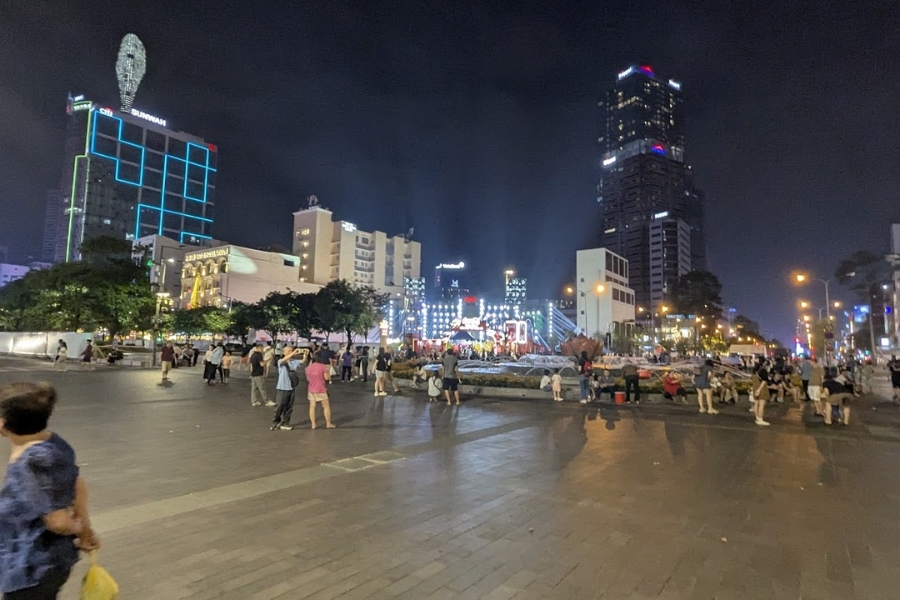
Nguyen Hue Walking Street is best experienced on foot. Its appeal lies in moving without urgency, in the freedom to arrive casually, stay as long as feels right, and leave when the atmosphere shifts.
Staying centrally allows Nguyen Hue to become part of an evening walk rather than a destination that requires planning. The experience feels unforced, woven naturally into the rhythm of the day.
For guests staying at Hôtel des Arts Saigon, this balance is especially evident. Located in District 3, just beyond the intensity of the city’s busiest streets, the hotel offers a refined counterpoint to active public spaces like Nguyen Hue. The distance is close enough to remain connected, yet far enough to allow the pace to soften on return.
After time spent among crowds, light, and movement, returning to Hôtel des Arts Saigon brings a sense of contrast. Spaces grow quieter. The tempo slows. Moments settle. In this way, Nguyen Hue Walking Street fits naturally into a central Saigon stay, not as an experience to extend indefinitely, but as one to absorb and then gently leave behind.
Nguyen Hue Walking Street is not a place to complete, but one to notice. Its value lies not in a checklist of activities, but in what it quietly reveals about the city.
Here, Saigon is experienced through shared presence rather than constant action. People gather without instruction. Moments unfold without schedule. Sitting, walking, or simply watching can feel equally complete.
What remains after leaving Nguyen Hue is not a single highlight, but an impression, a sense of how the city breathes in public, how it shares space, and how it moves between energy and ease. Seen in this light, Nguyen Hue Walking Street becomes a reference point within a Saigon journey, not a destination that demands attention, but a place that lingers precisely because it does not.
Follow our hotel on: